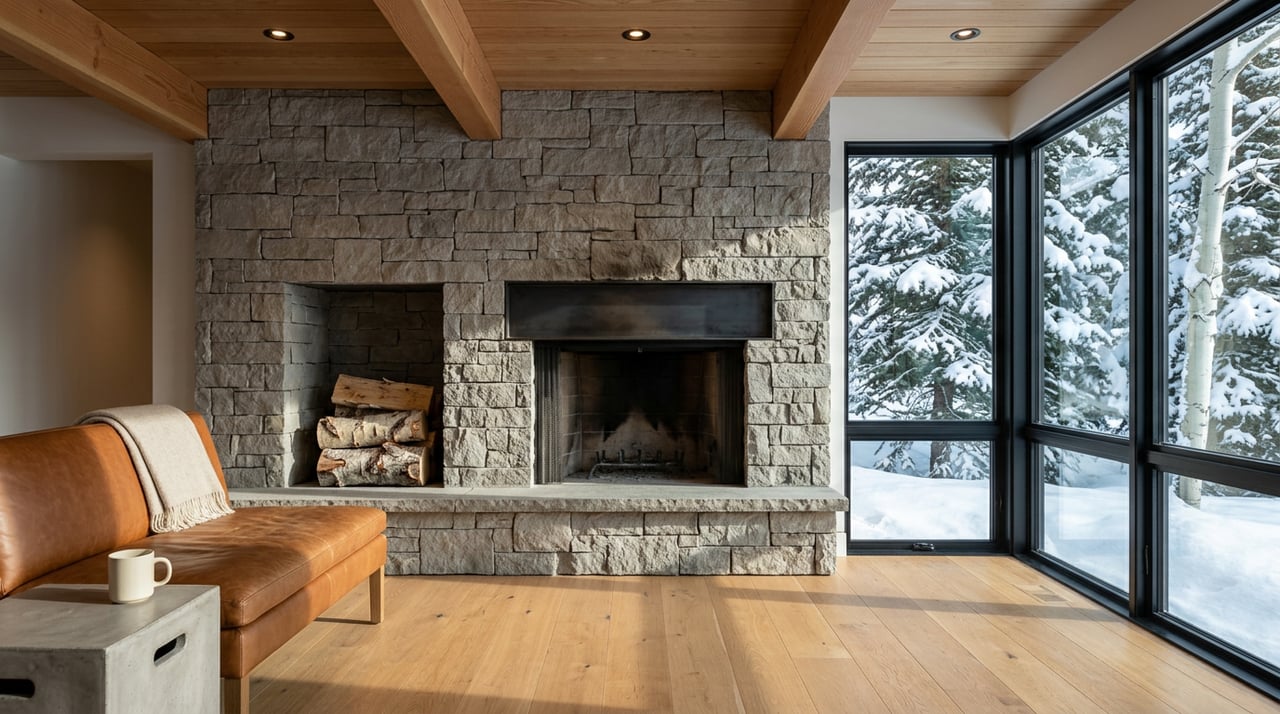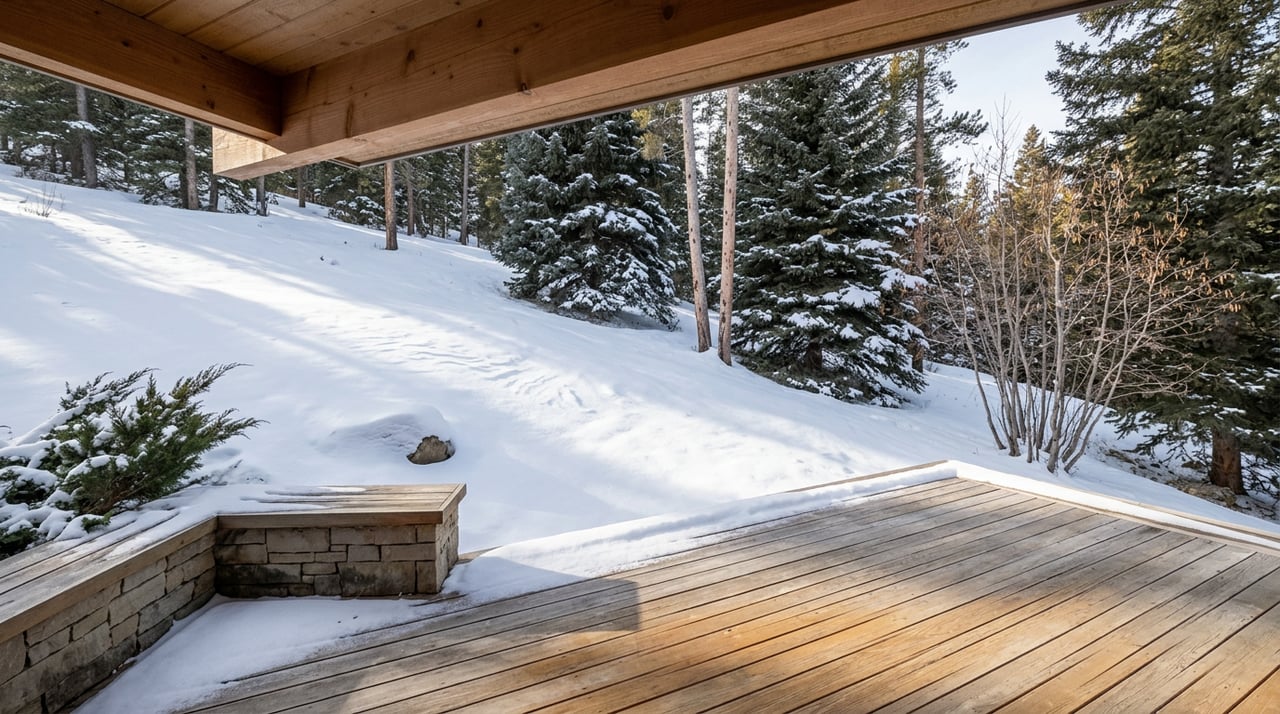
Two homes sit inside Ridge Run, the same subdivision, a few minutes apart on foot. Both list as ski-in/ski-out. Both sit inside a subdivision that has carried that label since the 1980s. One owner steps off a back deck onto ungroomed snow and glides to the lift with no more effort than tying a boot. The other owner walks down, and down, and down some more, because the lot sits lower on the mountain where the pitch runs out before it reaches a run worth skiing. Ridge Run was built in stages across roughly 194 homesites, and the upper lots ski out with far more ease than the lower ones, which were platted as the subdivision grew down the hillside toward Base Village.
That gap inside a single subdivision is the thing a median price per square foot will never show you. If you are comparing on-mountain neighborhoods in Snowmass Village this year, the subdivision name on the listing tells you less than you think. The lot's position on the slope tells you almost everything.
The label covers more ground than the access does
"On-mountain" and "ski-in/ski-out" get used as if they describe a single product. In Snowmass Village they describe a category that spans at least six distinct subdivisions, each platted in a different decade, each with its own relationship to a lift, a trail, or a shuttle stop. Wood Run, along Fanny Hill, was the first single-family subdivision built around direct ski access, laid out with roughly 123 single-family lots alongside more than a hundred condo units, close enough to the Village core that access to the lower mountain is about as consistent as anything on this list. Ridge Run came next, at the literal base of the mountain, where the terrain itself does the sorting between upper and lower lots. Two Creeks followed in the late 1990s and early 2000s on the mountain's eastern side, built around near-acre lots and the Two Creeks lift, deliberately set apart from the Base Village crowd and feeding skiers up toward Elk Camp. The Pines at Owl Creek came a few years later, adjacent to Two Creeks, 51 lots among some of the newest and largest homes in the village, where ski access is present on every lot but not identical from one lot to the next. The Divide holds 42 large parcels with easy access along the Dawdler trail on one side and a longer, more advanced route toward the Campground lift on the other. Sinclair Meadows is the newest of the group, coming online in 2008 and 2009 with its first sale in 2010, positioned more around land value and proximity to the Snowmass Country Club golf course than around ski access at all.
| Subdivision | Era | What sets the access apart |
|---|---|---|
| Wood Run (Fanny Hill) | First single-family ski-access subdivision | Groomed, close to the Village core |
| Ridge Run | 1980s | Upper lots ski out easily; lower lots require a longer, ungroomed descent |
| Two Creeks | Late 1990s to early 2000s | Near-acre lots feeding the Two Creeks lift toward Elk Camp |
| The Pines at Owl Creek | Early 2000s | Every lot has access, but ease varies lot to lot |
| The Divide | Established, large parcels | Easy along Dawdler trail, harder toward Campground lift |
| Sinclair Meadows | 2008 to 2010 | Land-value driven, adjacent to the golf course, not primarily an access play |
Two lines in that table, Ridge Run and The Divide, describe the same phenomenon in two different places on the mountain: a subdivision-wide marketing term sitting on top of a lot-by-lot reality. A buyer working from a listing sheet alone has no way to tell which side of that line a given parcel falls on.
The price data is already telling this story
Look at what happened to Snowmass Village pricing across 2025. The median single-family home sale climbed to $8.25 million, up 11 percent from the year before, according to year-end figures reported by the Aspen Times. Over that same stretch, the median condo sale fell to $2.09 million, down 20 percent. One product type in the same town got materially more expensive while the other got materially cheaper, in the same twelve months.
That is not noise. A single-family home on the mountain is being priced as a fundamentally different asset than a condo in Base Village, and the subdivisions where true upper-lot access still exists, the ones where a buyer can actually confirm doorstep skiing, are the scarcest inventory in the whole market. Confirmation of that scarcity showed up again in March 2026, when a ski-in/ski-out home on Bridge Lane in Snowmass Village closed at $15.25 million, or roughly $3,040 per square foot, furnished. That is trophy pricing for trophy access, and it is consistent with a market where the difference between an upper lot and a lower lot in the same subdivision is no longer a footnote. It is the transaction.
The volume behind the price is thinner than it looks
The catch for anyone reading only the price headline is that 2026 opened slower than any first quarter since 2020 across the broader Aspen and Snowmass market, with March closed sales in Snowmass falling 46 percent year over year, from 13 transactions to seven, according to the same Aspen Times reporting. Days on market have also stretched. Trailing three-month data through April 2026 put the typical Snowmass Village home at 51 days on market, up from 38 days the year before, with 24 homes sold in April against 49 a year earlier.
Fewer transactions, slower absorption, and a rising single-family median all sitting together mean the same thing: the buyers who are still transacting are highly selective, and they are paying up for the specific lots that deliver on the access promise rather than settling for whatever the subdivision name implies. That selectivity is exactly why the upper-lot, lower-lot distinction inside Ridge Run and The Divide matters more in this market than it would have three years ago, when almost anything with a ski-access label sold quickly regardless of the actual walk.
Access also changes the rental math
If you are weighing one of these homes as an income property and not only a residence, the access question follows you into the permit paperwork. Snowmass Village requires a business license and a short-term rental permit for any stay under 30 days, and the town moved to a $400 annual permit fee effective January 1, 2026, with every permit now expiring on the same date, April 30, rather than on a rolling schedule tied to when the owner first applied. Single-family homes and duplexes fall under a permit category that carries its own minimum-stay rule, a four-night minimum, which is a meaningfully different booking pattern than the nightly flexibility a Base Village condo-hotel can offer. The town's short-term rental page lays out the current permit types and fee schedule directly, and it is worth reading before you model a year of bookings against any one property.
A true upper-lot home in Ridge Run or Two Creeks, where a guest can walk out the door and ski, holds its winter rate through more of the season than a lower-lot home where the same guest needs a car or a longer walk to reach the lift. That difference shows up in occupancy during the exact weeks, Christmas through New Year's, Presidents' Day, that carry the highest rates of the year. A home that markets itself as ski-in/ski-out but delivers a walk instead loses some of that peak-week pricing power precisely when it matters most.
What to actually verify before you write an offer
- Ask for a recorded easement or plat showing the specific ski access serving that lot, not the subdivision as a whole.
- Request winter photos or a short video of the actual route from the door to snow, taken in a normal snow year rather than a powder day.
- Check whether the run reached from that lot is groomed or ungroomed, and whether it connects to a lift or only to a lower trail that eventually requires a shuttle.
- Review the HOA's snow removal and access maintenance obligations, since some subdivisions place that cost and responsibility on individual owners rather than a shared association.
- Confirm the STR permit type the home would qualify for and the minimum-stay rule that comes with it, since that shapes realistic rental income far more than the subdivision name does.
None of this shows up in a listing photo taken at midday in July. It shows up in the plat, in the HOA documents, and in a conversation with someone who has actually walked the route in February.
A few common questions
Does every home in these subdivisions actually have ski access? Most lots do, but "access" ranges from a literal doorstep run to a walk of several minutes to reach groomed snow. The subdivision name confirms the neighborhood, not the specific route from any one lot.
Is Ridge Run less expensive than Wood Run or Two Creeks because the access is worse? Ridge Run does tend to price at a relative discount to some of the newer enclaves, but that discount applies unevenly. An upper Ridge Run lot with true doorstep access can outprice a lower-lot home in a nominally more prestigious subdivision.
Does the short-term rental permit type change based on which subdivision the home sits in? The permit type depends on the property's classification, whole-ownership single-family or duplex versus a centrally managed condo-hotel building, not on the subdivision name itself. Confirm the classification and the applicable minimum-stay rule directly with the town before assuming a rental projection.
Is now a slower time to buy in these subdivisions? Transaction volume is down and days on market have lengthened compared to a year ago, which gives buyers more room to do the access due diligence outlined above before competing offers force a fast decision.
Comparing subdivisions by name gets you partway there. Comparing lots by grade, easement, and permit type gets you the rest of the way. If you are weighing a specific address against the on-mountain alternatives in Snowmass Village, Lindsey Lane Bush can walk the access, pull the HOA documents, and run the rental numbers before you write an offer. Schedule a free consultation to start with the specific lot, not the subdivision brochure.